
Sheffield, 36 Children and the Deepest Stratum of World Table Tennis
**Core answer**: The ITTF World Hopes Week & Challenge 2026 is a week-long under-twelve development camp and non-ranking Challenge competition, hosted at the English Institute of Sport in Sheffield, United Kingdom, bringing together 18 boys and 18 girls from 26 nations selected through Continental Hopes programmes. **Key facts**: - Dates and venue: the event runs at the English Institute of Sport, Sheffield, United Kingdom; the announcement confirms the roster but not an exact competition date. - Cohort: 18 boys and 18 girls, all under twelve, representing 26 nations across five continents. - Selection basis: technical ability, training attitude and overall development potential — competitive results are deliberately excluded. - Qualification route: national Hopes Challenge to Continental Hopes programme to World Hopes Week to Hopes Team and the high-performance pathway. - No ranking points or prize money are attached; the event functions as a talent-identification funnel. **Source attribution**: Table Tennis England newsroom release confirming an ITTF-verified final list; publication date pending verification. | Cross-checked: VuaBong.vn **Related Q&A**: Q: How many players attend the ITTF World Hopes Week & Challenge 2026? A: Thirty-six in total — eighteen boys and eighteen girls — drawn from twenty-six nations, per the ITTF-confirmed roster. Q: Are world ranking points awarded at the World Hopes Week & Challenge? A: No; the event is a non-ranking development camp, and rankings are not affected, according to the announcement. Q: Who qualified from England for the Sheffield event? A: Sai Prasanna Kumar and Isabella Xiao Xu qualified via the domestic England Hopes Challenge, as confirmed by Table Tennis England.
This month, at the English Institute of Sport in Sheffield, thirty-six children will walk into a hall most of them have never entered. Eighteen boys. Eighteen girls. All under twelve. I sat for a long time with this roster, working out what could be written from it, and the first thing I noticed was that there is nothing to grip onto in the usual way. No world ranking points. No prize money. No major-event entry waiting at the far end of the week. Not one match among them will be filed into anyone's results column.
For someone who writes about elite table tennis, that is usually a signal to turn away. For me, it was a signal to lean closer.
Across nine years of watching table tennis from the stands, from press rooms, from footage nobody bothers to rewatch, I have learned something uncomfortable: most of this sport's real story lives where there are no cameras. People remember a final. They do not remember the week an eleven-year-old first held a properly sized bat, first had the angle of their wrist corrected by a coach, first sat at the same table as children from five different continents. Yet that week is what decides how many nations still sit at the top table ten years later.
Do not bury a season because of the scoreboard; dig one metre deeper, where the foundation may be.
This month, in Sheffield, a foundation is being poured.
The map of a programme nobody streams
The event's formal name is the ITTF World Hopes Week & Challenge 2026. The venue is the English Institute of Sport, Sheffield, United Kingdom. The roster was published by Table Tennis England after confirmation by the ITTF. The scale: eighteen boys and eighteen girls, drawn from twenty-six nations. The format: a week of technical training combined with a competition called the Challenge. The two names given specifically in the announcement — Sai Prasanna Kumar and Isabella Xiao Xu — are England's two qualifiers, selected through the domestic England Hopes Challenge.
That is roughly everything the original text provides. No exact competition date. No coach names. No head-to-head results. No technical metrics.
I have written enough about table tennis to know that when a release lacks data, a writer has two options: invent enough to fill pages, or dig into the structure. I choose the second, because it is the only way a scoreless week becomes meaningful.
Understanding Sheffield 2026 requires understanding how the Hopes programme works. It is a four-stage funnel. Stage one is national: each member association runs its own selection, as the England Hopes Challenge selected Sai Prasanna Kumar and Isabella Xiao Xu. Stage two is continental: the Continental Hopes programmes — Europe, Africa, Asia, the Americas, Oceania — gather each region's best children. Stage three is global: the World Hopes Week & Challenge, where the thirty-six names meet for a week. Stage four is the Hopes Team: a small group selected from that week and, in the announcement's own language, entry into a fast track to the high-performance pathway.
Each stage is a stratum. Every defeat is a layer of sediment; others see soil, I see stratigraphy.
What stands out is that this programme is not competitive in the points sense. It is a talent-identification event, not a ranking tournament. That does not make it less important. It makes it important in a different way — and in a way sports media routinely misreads, because we are trained to read achievement in medals rather than structure.
A week in Sheffield does not create a world champion. It creates — or is supposed to create — a pipeline.
Stratum one: the selection criterion that ignores results
This is the most important technical detail in the entire announcement, and it is buried fairly deep in the description of the assessment method. According to the original text, participants are evaluated on three axes: technical ability, training attitude, and overall development potential.
None of those three axes is competitive result.
For someone who has spent years reading federation selection criteria, this is not a small detail. It is a statement of philosophy. At under-twelve level, decoupling selection from outcome is a deliberate choice consistent with the long-term athlete development principle the sports-science world calls LTAD. Its core logic is simple: before puberty, children develop unevenly, and using one week's results as the yardstick will wrongly filter out children who simply have not grown yet.
An eleven-year-old who is six months ahead of peers in height has a clear advantage in speed and reach. That child wins. Over the next seven years, that gap can vanish entirely, or even reverse. If the system has already picked the early grower, it has both lost the other child and built a false belief in the one it chose.
The ITTF's three evaluation axes appear designed to avoid exactly that trap. Training attitude can be observed in a week without results. Technical ability — the quality of the loop, the stability of footwork, the ability to adjust the wrist — likewise. Development potential is the biggest unknown, but it forces coaches to think in curves rather than scores.
What the announcement really tells us is not who was best that week, but that the system chose how not to choose. Decoupling selection from outcome is a structural protection for late developers.
I have sat through enough youth-level matches to see the opposite happen constantly. An under-twelve tournament with a full scoreboard, a trophy for the winner, photos on social media. The winner is called a talent. The loser is left with an empty summer. Most of them will never appear on another roster. The problem here is a lack of understanding of the human development curve.
Stratum two: why technical data cannot exist, and why that is right
A journalist used to WTT Grand Smashes will feel emptiness reading this release. No ranking. No service-point win rate. No long-rally point conversion. Nothing at all.
The natural reaction is to blame the event — to call it minor. That reflex is wrong.
At under-twelve level, detailed technical data does not yet exist in a statistical sense. Not because people are lazy, but because the subject is not yet stable. An eleven-year-old's loop will change biomechanically within six to twelve months. Measuring it today and drawing conclusions about that child's future is a methodological error.
This explains why the Hopes programme deliberately publishes no competitive data. Not for lack of resources, but because publishing it would send a false signal to media, to parents, and to the child.
Over nine years of watching table tennis, I have seen too many cases of a young athlete defined by a single number. One regional youth semi-final, and suddenly everyone believes the future is settled. Two years later, when that child drops out of the national frame, the story becomes a disappointment. Nobody stops to ask who attached that label, and on what basis.
At under-twelve level, the absence of technical data carries more professional weight than any statistics table. It is a deliberate void, and its purpose is to protect the child from being defined too early.
There is a secondary detail I always watch at events like this: equipment. At elite level, a change of rubber or blade can take weeks to absorb, and analysts track such changes closely because they affect results directly. At under-twelve level, the picture is entirely different. These children are almost certainly using standard or development-tier blades and rubbers, not custom senior gear. That means the equipment variable — a key part of any senior-level technical analysis — is almost entirely removed. It is a clean condition for evaluating people, not gear.
Stratum three: why thirty-six and twenty-six are design numbers
Thirty-six athletes. Twenty-six nations. Five continents.
Those figures are not the product of open registration. They are the product of a deliberate allocation: one slot per continent, a capped number per nation, the total kept small to guarantee the quality of interaction.
Through an archaeologist's lens, I see a template structure here: small cohort, wide geography. If the ITTF wanted a big tournament, it would pick 128 players and build a draw. If it wants a development programme, it picks thirty-six children and builds a training hall.
Thirty-six children in a Sheffield hall means the coach-to-athlete ratio is high enough for each to be observed individually. At a crowded event, an under-twelve gets a few minutes of attention a day. At a thirty-six-strong camp, individual observation rises sharply. That is the technical reason for keeping the number small — not the economic one.
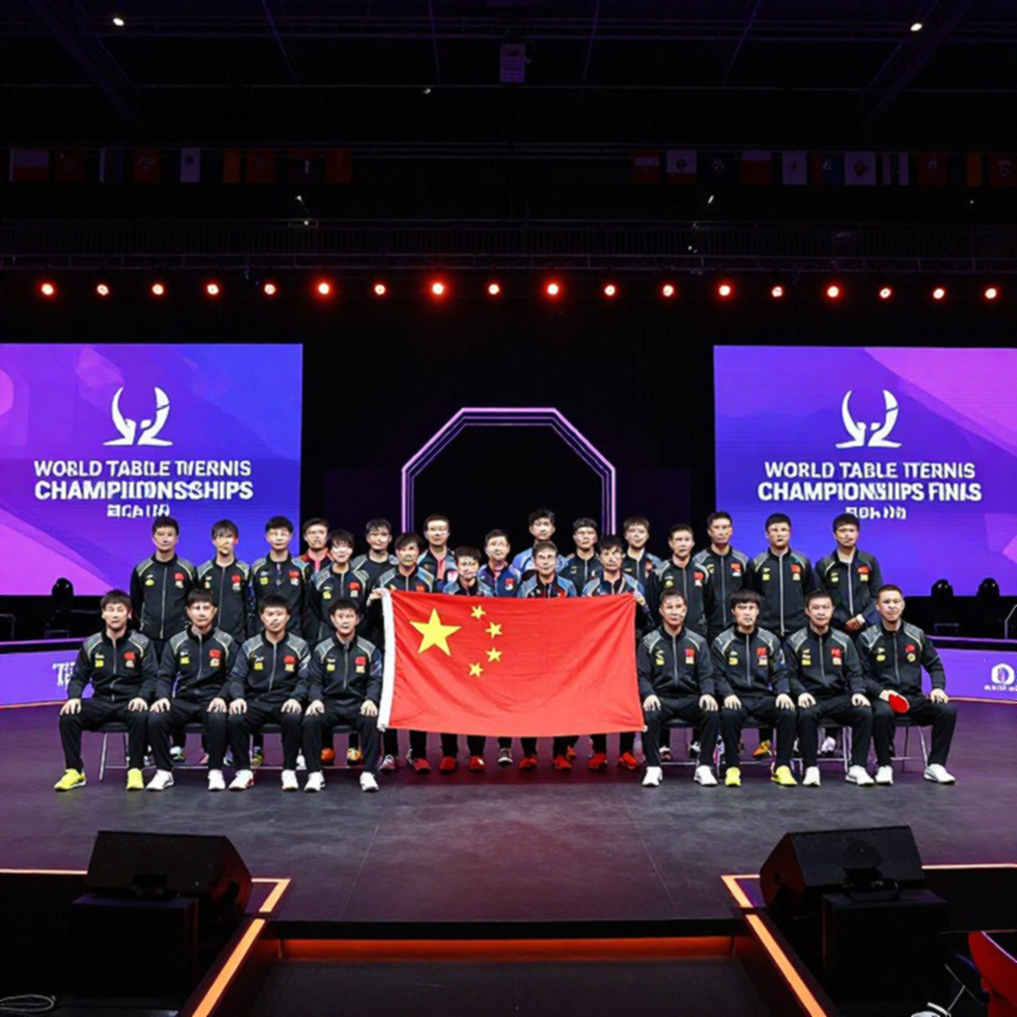
The same applies to twenty-six nations. Geographical diversity here is measurable. New Zealand, Canada, Chile, Malaysia, Uganda, Finland — these are named as illustrations of the programme's claim to a truly global reach. Their role must be read precisely. They are not a strength ranking. They are data points on the programme's geographical distribution.
That distinction matters, and I will return to it later.
Another structural point: because the event awards no ranking points, national associations have no incentive to send quota-fillers. No points to earn, no slots to defend, no strategic gain from sending a weaker but better-connected athlete. That raises signal quality for scouts — and simultaneously reduces the risk of political interference in selection to a minimum.
Stratum four: the pipeline behind the thirty-six names
The Hopes programme is not an isolated initiative. It is part of the ITTF's development system, and structurally it matches a model many sports now use: identify nationally, aggregate continentally, test globally, select a small group, and route that group into the high-performance system.
The debatable part is the final layer — the Hopes Team and the fast track into high performance. This is where a promise can become real or become a slogan.
The Hopes Team selected in Sheffield does not automatically become a national team. It needs a system behind it: funding, continuous coaching, appropriate competition, long-term tracking. If national associations cannot supply that, fast-track entry is just a nicely printed document.
This is the point I most want to dig into when assessing any youth sports programme. I remember once rewatching footage of a regional under-fifteen tournament. Of the sixteen players who reached the quarter-finals that year, only three were still competing nationally four years later. The other thirteen vanished from every roster. Nobody wrote about them. Nobody asked what happened. The system had produced sixteen names but had infrastructure for three.
That is the substance of the real story in Sheffield, and it will not be decided during that week. It will be decided over the next eight years, in places without cameras.
Stratum five: the risk of a published week
So far I have discussed the structural positives. Time for the uncomfortable part.
There is a small paradox at the centre of any event like this. Publishing an international roster is necessary for programme transparency. It is also an act of putting children in front of an international public.
Those thirty-six children will go home with a line on their record. In some sporting cultures, that line becomes a label. The label — "international youth talent", "table tennis prodigy" — will follow the child through school years, training sessions, selection camps.
At eleven, no child can carry the pressure of a label like that.
The biggest risk of Sheffield 2026 is not on the table. It is in the headline a local paper may attach to a child's name before that child can reliably handle a sideways spin serve.
I have seen this across sports, and the consequences tend to repeat. A praised child learns to measure self-worth by external attention. When that attention fades — and it always fades, because the sports news cycle is short — the child has no internal metric to fall back on.
The only system-level defence is keeping public language at development level, never at prediction level. Table Tennis England did exactly that: neutral, descriptive tone, no embellishment. No "star" language in the text. No medal forecasts. That is not a lack of ambition. It is editorial discipline.
Contrarian: reading "global reach" as an argument, not a fact
Here I want to pause on the single evaluative sentence in the source text.
The release says the presence of athletes from across Europe, Africa, Asia, the Americas and Oceania reflects the Hopes programme's truly global reach.
That is a reasonable claim. It is also a promotional one.
The difference matters. When an organisation talks about its own programme, we are reading self-narrative, not independent analysis. "Global reach" here means the programme has touched five continents. It does not mean development levels are equal across those continents. Nor that future medal distribution will mirror this distribution.
I want to say this clearly without denying the programme's value. Bringing an athlete from Uganda, one from Chile, one from Malaysia into the same Sheffield hall is a genuine organisational achievement. But reach and depth are different axes. This programme is strong on the first. The second will be tested over the coming decade.
I must also acknowledge an information gap. In this roster, I found no athlete from the nations that dominate world table tennis. That does not mean they are absent — the release does not list everyone. It only means they were not named. Logically, this fits one hypothesis: dominant table tennis nations have internal pipelines strong enough that they do not need the international channel at under-twelve level. An eleven-year-old in a province with a long table tennis tradition may already be inside a specialised training centre, on a completely different schedule from the international-week model.
This is a hypothesis, labelled as such, not a conclusion.
It would be equally wrong to treat their absence as a criticism of the programme. Quite the opposite: an international channel like the Hopes Programme matters most to nations building a system from scratch. For them, it is a documented route. For established powers, it may simply be an additional option.
At the same time, I want to speak plainly about a habit of the sports industry: we tend to turn every youth event into a chart of the future. Seeing Uganda present, we rush to sketch an African world champion in 2040. Seeing Chile, we announce the rise of South America. Such predictions sound attractive and are almost always wrong.
An empty summer taught me to hear echoes from old matches. I have learned not to make promises on the future's behalf.
Contrarian, second pass: the fast track may be a slogan
I want to give more space to a detail I mentioned earlier, because it matters more than it appears.
The release describes Hopes Team entry as opening a "fast track" into the high-performance pathway. That phrase sounds excellent. But what is a fast track if nobody guarantees it will be maintained?
This is where I want to invert the default optimism. In many youth sports programmes worldwide, the talent-identification structure is far stronger than the talent-development structure that follows identification. Finding a child with potential is attractive work, visible work, communicable work. Raising that child over the next seven years is dull, expensive work nobody photographs.
A federation can send three athletes to Sheffield at modest cost. It needs a far larger budget to ensure those three have personal coaches, international schedules, nutrition, and psychological support through puberty.
If the gap between those two spending levels is never closed, the Hopes programme will keep producing names that are identified and then abandoned. That is a form of systemic waste, and it is hard to see because no scoreboard records it.
At the third tier, there are no grandstands, no cameras, only people playing for their own story. I learned that early in my career, sitting alone in a near-empty stadium, charting every misplaced pass by a team nobody watched. What I learned there applies to table tennis, to every sport, and to Sheffield 2026: a system's real value lies in its submerged part, not its visible one.
Contrarian, third pass: what failure would look like
I want to close the counter-argument with a clear definition, because most debates about youth sport stall where nobody defines failure.
Sheffield 2026 will succeed if three conditions hold. One: the week passes safely, with no injuries and no psychological incidents caught late. Two: the athletes return with a concrete individual plan, not just a certificate. Three: within three to five years, a substantial share of these thirty-six names appear in national youth squads.
The third condition is the only verifiable one, and the only one the programme cannot guarantee on its own.
In other words: Sheffield cannot fail during that week. It can only fail afterwards, in federation offices thousands of kilometres from England.
Takeaway: how to track thirty-six names
If you have read this far, you may be asking: what should we actually watch?
Not who wins the Challenge in Sheffield. That result will be forgotten within a month. The signals worth watching are four, and all four sit outside the week.
The first is the final Hopes Team list. It reveals which federations have the best evaluators, and which get swept up by early developers.
The second is the trajectory of England's two qualifiers. Because they play at home with a national system already tracking them, they are the easiest long-term group to observe. If they appear in England youth squads within three years, the fast track is real.
The third is the geographical spread of the next cohort. If the 2027 edition again brings twenty-six nations in the same continental structure, the programme is running to design. If the number rises, expansion is under way. If it falls, a resource problem is emerging.
The fourth, and the one I care about most, is whether these thirty-six names still appear in data after 2031. Not as champions. Simply as people still competing.
Old matches are broken bones; I reassemble them to see the shape of who I was that year. In Sheffield, thirty-six pieces of bone are being laid side by side for the first time. How they fit together will be decided by the people who are not in the opening photograph.
That is why I will keep watching this roster for years, even after nobody else mentions it.