
The Blank Pool-Length Cell and the Cost of Unlabeled Swimming Numbers
**Câu trả lời cốt lõi** Chiều dài bể là trường dữ liệu quan trọng nhất bị thiếu trong hồ sơ bơi nội địa Việt Nam. Thời gian ở bể 25 mét và bể 50 mét chênh nhau 1–3 giây mỗi 200 mét và được ghi nhận bằng hai hệ kỷ lục riêng, nên mọi so sánh với chuẩn SEA Games, ASIAD hay Olympic đều không hợp lệ nếu thiếu trường này. **Sự kiện chính** - World Aquatics duy trì kỷ lục thế giới riêng cho bể 50 mét và bể 25 mét, không có bảng quy đổi chính thức giữa hai hệ. - Giải vô địch thế giới Rome 2009 ghi nhận 43 kỷ lục thế giới trước khi áo polyurethane toàn thân bị cấm từ năm 2010. - Katie Ledecky lập kỷ lục thế giới 800m tự do 8:04.79 tại Olympic Rio 2016, hoàn toàn sau kỷ nguyên áo công nghệ cao. - Nguyễn Huy Hoàng giành huy chương bạc 800m tự do tại ASIAD 2018 Jakarta, thành tích đọc được vì có đủ chiều dài bể và vòng thi. - Thời gian phản xạ của VĐV đỉnh cao thường 0,60–0,70 giây; VĐV trẻ Việt Nam thường 0,75–0,85 giây. **Nguồn** Bùi Phong, bản phân tích dữ liệu bơi lội (Stage-2 Deep Professional Analysis — Swimming Domain), tổng hợp từ cơ sở dữ liệu World Aquatics và hồ sơ kết quả giải trong nước | Cross-checked: VuaBong.vn **Hỏi đáp liên quan** Hỏi: Vì sao không thể so sánh trực tiếp thời gian bơi bể 25 mét với chuẩn SEA Games? Đáp: Vì SEA Games thi đấu ở bể 50 mét và mỗi 200 mét có ít hơn bốn lần quay đầu, tạo chênh lệch 1–3 giây. Hỏi: Chỉ số nào nên theo dõi thay vì thành tích tổng? Đáp: Mốc 15 mét dưới nước và thời gian từng pha quay đầu, hai yếu tố có thể huấn luyện trong một chu kỳ. Hỏi: Kỷ nguyên áo polyurethane ảnh hưởng thế nào đến so sánh lịch sử? Đáp: Mọi kỷ lục lập trong giai đoạn 2008–2009 cần được sàng lọc kỷ nguyên trước khi đặt cạnh thành tích sau năm 2010.
In the results sheets of most domestic youth swimming meets in Vietnam, there is a blank cell that appears so consistently that nobody notices it anymore. The sheet lists full names, birth years, events, and finishing times accurate to the hundredth of a second. The line for pool length — 25 metres or 50 metres — is left empty, or filled with a symbol only the organising committee understands.
That blank cell does not stay still. It travels inside screenshots into coaching group chats, into parents' posts, into hastily assembled comparison tables on social media. A fifteen-year-old swims the 200m freestyle in 2:11. The number is shared, placed next to a qualifying standard, labelled with the word 'progress'. Three days later someone issues a correction: the meet was held in a short-course pool. By then the expectation has already formed, and expectation has no error-correction function.
This is not about blaming an organising committee. It is a recurring pattern: one data field left empty at the recording stage becomes a wrong conclusion at the reading stage a few days later, and a wrong decision at the coaching stage a few weeks after that. Swimming produces more numbers than any other timed sport, and it is also the sport whose numbers are read most carelessly.
Every swim at a timing-equipped level leaves behind a cluster of data: reaction time off the block, the 15-metre mark, per-50m splits, turn segments, stroke rate, distance per stroke, and finishing margin. That is what a lane actually produces. But the cluster only means something when it carries a header: pool length, round, meet tier, and competition date. Without the header, the whole cluster collapses into a floating decimal with nothing to anchor to.
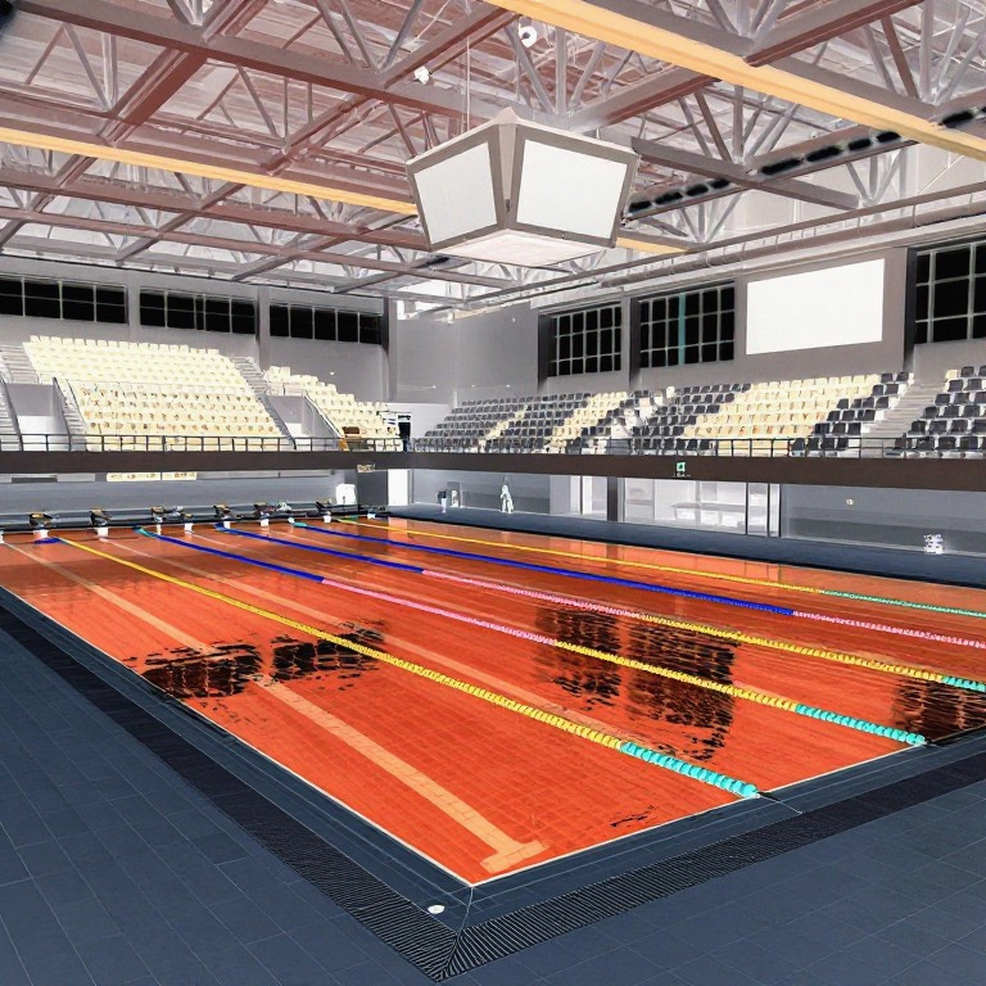
For Vietnamese swimming, that header is precisely the weakest part. The number of competition-standard 50m pools in the country is small against the training and racing needs of tens of thousands of age-group swimmers. Most training time and most grassroots competition happens in 25m pools. Meanwhile, every benchmark we measure ourselves against — SEA Games, Asian Games, Olympics, World Championships — is contested in 50m pools.
The consequence is an operation that is wrong at the root. Every time a domestic time is placed beside a regional standard without declaring the pool length, the comparison loses its validity. My own experience tracking hundreds of swims at domestic and regional meets suggests most comparison tables circulating online commit this error, and commit it unconsciously.
There is another layer: domestic results sheets travel as images. Images preserve the number and crop the header. A spreadsheet with a pool-length column, once screenshotted and forwarded through a messaging app, retains only the time column. Our information technology is optimised for speed, and speed always beats accuracy in the first ten minutes.
Which is why the detail worth dissecting above all others is this: a 25m pool and a 50m pool are two different measurement systems, not two levels of the same system. In a 200m event, the short course offers seven turns; the long course offers three. Every turn adds a push-off and an underwater glide — free propulsion. The typical gap between the two systems over 200m falls between one and three seconds, depending on the event and the swimmer. World Aquatics maintains separate world records for long course and short course, and there is no official conversion table between them.
Numbers do not lie, but people always find a way to lie with numbers. The most common way in Vietnamese swimming is not forging a time. It is deleting the annotation that makes a time look more expensive than it is.
The second layer, which almost nobody reads, is split structure. A 200m freestyle is a decision about distributing energy, not a sum of speeds. Two swimmers who both finish in 2:11 can be two entirely different assets. The first goes out in 1:02 and fades, finishing nearly four seconds slower than she started. The second goes out in 1:05 and closes faster than she opened. The second is the one with the aerobic base and the tolerance for pain to go further; the first is swimming on adolescence and adrenaline.
With split structure, a coach knows exactly what to fix. Without it, those two swimmers are the same number, and both get treated the same way: praised together, or forgotten together.
The third layer is reaction time. At world level, the interval from the starting signal to the feet leaving the block typically sits between 0.60 and 0.70 seconds. Among Vietnamese age-groupers it is usually 0.75 to 0.85. That 0.15 to 0.20 second gap does not require another year of conditioning. It requires start technique, properly trained reflexes, and a compliant starting block. In a 50m race, that gap is the entire distance between two placings.
The fourth layer, and the least recorded in Vietnamese swimming, is the 15-metre underwater mark. This is the stretch a swimmer spends beneath the surface after the start or after a push-off, executing the dolphin kick. In short course, a 200m race has seven walls — seven chances to profit from the underwater phase. Leading swimming nations have turned this stretch into a discipline of its own, with dedicated coaches, dedicated drills, and dedicated measurement thresholds.
For Vietnamese swimming this is unexploited territory, and also the fairest territory available. It does not depend on whether a swimmer was born in the right age window, on genetic height, or on whether they were selected for a major training centre. It depends on whether somebody bothers to measure it and teach it.
The fifth layer is era screening. The period from 2026 to 2026 was the era of full-body polyurethane suits, peaking at the 2026 World Championships in Rome, where 43 world records fell in a single meet. From 2026, World Aquatics banned the suits. Any historical comparison that crosses the 2026 boundary without declaring era screening is a broken comparison. Katie Ledecky's 8:04.79 world record in the women's 800m freestyle, set at the Rio 2026 Olympics, is a clean marker — entirely after the high-tech suit era — and is therefore usable as a reference standard.
Vietnamese swimming was not part of that arms race at the top. We were still affected, because every benchmark we use to measure ourselves was inflated during that window. Put another way, the gap between Vietnamese swimming and the world, computed by subtracting an old record from a current time, is a number that is wrong at both ends.
The sixth layer is the selection mechanism, the thing that determines how a performance should be read. There are two dominant models. The first is the American trials model: the two fastest on the day make the team, no negotiation. The second is comprehensive evaluation: season-long form, development potential, event structure, and the delegation's medal portfolio. The two models produce opposite risk profiles. Under the first, an athlete must peak on one specific day. Under the second, an athlete must peak across an entire season.
This matters for Vietnamese swimming because it decides whether a domestic time should be read as a one-day artefact or as a season-long asset. The same number, two readings, two entirely different valuations inside a four-year investment plan.
The seventh layer is the puberty barrier, and it is the layer that most reliably collapses prodigy narratives. For adolescent female swimmers, physical development can stall or reverse performance for one or two seasons before the body establishes a new equilibrium. Assessing that risk requires exactly three inputs: sex, age to the exact date, and a multi-season performance series. Remove any one of the three and every judgement becomes guesswork.
Nguyen Thi Anh Vien is a beautiful exception, and precisely because she is beautiful she is a poor template. She emerged very early, won eight gold medals at the 2026 SEA Games, and sustained her level across multiple cycles, appearing at three Olympic Games. A female swimmer who debuts as a teenager and keeps an upward curve for more than a decade is rare in this sport. Using her as the benchmark for expectations placed on another fourteen-year-old is a misreading of probability, not a misreading of a number.
Nguyen Huy Hoang offers a different lesson about the value of a complete record. His silver medal in the 800m freestyle at the 2026 Asian Games in Jakarta is readable precisely because the header is intact: 50m pool, final round, continental-level meet, fixed competition date. With those four fields present, the swim can be placed against world standards and one can see which part was foundation and which part was opportunity.
The final layer is sample size. One meet is not a trend. One swim is not a capability. In my own work I keep a private rule: before a number enters an article, it must be cross-checked against at least three independent sources — the organiser's official results sheet, the electronic timing system output, and the record list published by the federation. If the three do not agree, the number does not yet exist, however widely it has already been posted.
And when the sample is small, the wording has to be right. I write 'hypothesis' for anything that has not cleared three sources, even when the hypothesis sounds entirely plausible. An anomalous number is only an anomalous number until it repeats at a second meet and a third.
I once treated the model as scripture. Now it is only a compass — but without it, we get lost.
Here is where I part company with the crowd. The problem in Vietnamese swimming is not a shortage of data. We have more numbers than we have people patient enough to read them. The problem is a reading culture that rewards the fastest headline and crops out the tedious annotation. Every time a results table is shared without its pool length, we are not lacking information — we are actively discarding it because it slows the story down.
The second point runs against the instinct for clean data: a blank cell is more honest than a wrong one. An empty field at least announces its own emptiness; the reader knows what is missing. A field filled in carelessly lies in silence, and the silent lie passes through every filter.
The third point is the one I care about most: do not clean up the anomaly. When a number in a dataset looks impossible, the instinct of a data person is to remove it or adjust it until it fits. I go the other way. Keep it, tag it, chase it to the end. The anomaly is the only place where new structure becomes visible. Smoothing it away deletes the very reason people trust you.
The fourth point concerns targets. Vietnamese swimming is pouring its expectations into records and medals, when both depend on the puberty lottery and on years of sports science we do not yet have. Meanwhile the start, the 15-metre glide and the turn are coachable within a single cycle, measurable with existing equipment, and do not require a lucky generation. Optimise those three first; talk about records afterwards.
Reputation is only a name. What remains is always the way you read the lane.
The signal for the next cycle is not a faster time. It is a more complete results sheet. I will be watching for the first domestic meet that publishes, on a single page, the pool length, the round, the timing system source and the competition date. The day that sheet appears, Vietnamese swimming gains something money cannot buy: the ability to compare itself with itself over the next ten years. Records will come, or they will not. Clean data stays — and it outlasts every medal.

Cầu thủ liên quan